Skin & Dermatology11 min read
Laser Hair Removal Side Effects, Sessions and Skin Tone: What to Expect
Laser hair removal side effects explained: what is common, what is rare, how many sessions you need, darker skin tones and aftercare in Dubai's climate.
Laser hair removal is a frequently requested treatment in Dubai, and it is easy to see why. Shaving daily in the heat, waxing that leaves skin red and bumpy, and ingrown hairs that never settle all wear thin. Before booking, though, most clients have the same questions. Is it safe? What are the side effects? How many sessions will it take, does it work on darker skin, and is the result permanent?
The honest answers depend on your skin, your hair and how carefully the treatment is planned. This guide explains how the laser works, which side effects are common and which are rare, why a course is needed, and what year-round sun means for preparation and aftercare. To see how the treatment is delivered at our clinic, including the system we use and the areas we treat, our page on laser hair removal at Shookra covers it in detail.
How does laser hair removal work?
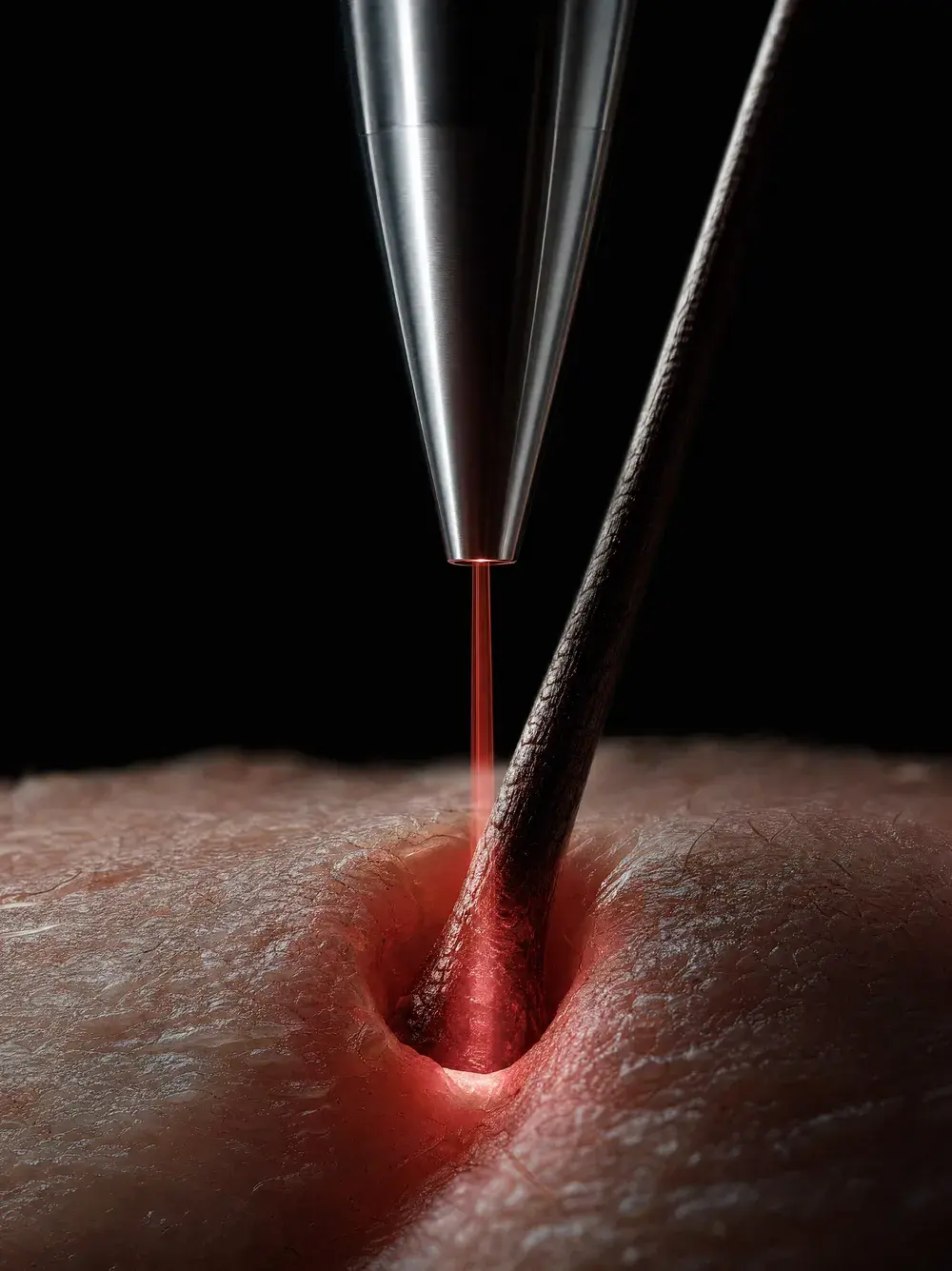
Laser hair removal works by selective photothermolysis: laser light is absorbed by melanin, the pigment in the hair, and converted into heat that damages the follicle and reduces its ability to regrow hair. It acts on follicles in their active growth phase, which is why a course of sessions is needed rather than one visit.
The principle was first described by Anderson and Parrish in 1983. Different structures in the skin absorb light at different wavelengths, so by choosing a wavelength that melanin absorbs well, and delivering it in carefully timed pulses, a laser can heat the follicle while largely sparing the skin around it. The hair shaft carries that heat down to the follicle, which is why the area is shaved beforehand: the hair needs to be present beneath the skin, but not on the surface, where it would simply singe.
Timing matters too. Each hair cycles through active growth (anagen), a short transition (catagen) and rest (telogen). The laser is most effective during anagen, when the hair is still attached to the pigment-rich base of the follicle. Only a proportion of hairs in an area are in that phase at any moment, so each session reaches a different group of follicles.
How many sessions of laser hair removal will you need?
Most people need a course of several sessions, and six to eight is a commonly quoted range for body areas. Facial hair and hormonally driven growth often need more, plus occasional maintenance. The exact number depends on the area, your hair colour and thickness, your skin tone and your hormones.
Sessions are spaced to follow the hair growth cycle, and hair grows at different speeds on different parts of the body. As a general guide only:
- Face, upper lip and chin. Often every four to six weeks, as facial hair cycles relatively quickly.
- Underarms and bikini line. Often every four to eight weeks.
- Arms, legs, chest and back. Often every eight to twelve weeks, as hair on larger areas tends to grow more slowly.
Many clients notice a meaningful reduction after the first few sessions, with regrowth becoming finer, lighter and patchier. Results vary, and your clinician will plan around your skin and hair rather than a fixed number.
Is laser hair removal permanent?
Laser hair removal can give a long-term reduction in hair, but it does not reliably remove every hair for good. Some follicles are disabled, others are weakened and regrow finer hair, and hormonal changes can stimulate new growth later. Many people need occasional maintenance sessions over time.
You may see the phrase "permanent hair reduction". It is a term used by the US Food and Drug Administration to describe a long-term, stable reduction in the number of hairs that regrow after a course of treatment. It does not mean every hair is gone, and that distinction is worth keeping in mind when comparing what clinics say.
What are the side effects of laser hair removal?
Common laser hair removal side effects include short-lived redness, mild swelling and small raised bumps around the treated follicles, usually settling within hours to a couple of days. Less common effects include temporary pigment changes, and rarely blistering, burns or scarring. Careful assessment and settings matched to your skin reduce most risks.
A 2006 review of adverse effects after laser and light-based hair removal by Lim and Lanigan concluded that side effects appear to be uncommon overall, and lasting ones very uncommon. That assumes careful assessment of who is treated and how, which is where most problems begin and end.
Common and expected
- Redness and warmth, like mild sunburn, typically fading within hours to a day.
- Swelling around the follicles, small goosebump-like bumps that are a normal response to the heat.
- Itching or tingling as the skin settles.
- Shedding of treated hairs one to three weeks later, which can look like regrowth but is the treated hair working its way out.
Less common
- Darkening of the skin (hyperpigmentation), more likely in deeper skin tones and on recently tanned skin. It is usually temporary but can take months to fade.
- Lightening of the skin (hypopigmentation), usually temporary, though occasionally longer lasting.
- Breakouts or inflamed follicles (folliculitis), particularly where skin gets hot and sweaty after treatment.
Rare
- Blistering, crusting and burns, most often linked to tanned skin, settings not matched to the skin type, or skipped aftercare.
- Scarring, usually following a burn or infection.
- Paradoxical hair growth, in which hair growth increases in or near a treated area. It has been reported mainly on the face and neck, more often in darker skin types and in people with hormonal conditions, and is not fully understood.
- Eye injury, which is why protective eyewear is a standard safety measure and treatment very close to the eyes is generally avoided.
People also ask whether laser hair removal can cause cancer. There is no good evidence that it causes skin cancer or any other cancer. The light is non-ionising, unlike X-rays, and its energy is absorbed in the skin and hair follicle. Clinicians generally avoid treating over moles, and any mole that is changing should be checked by a doctor rather than lasered.
Is laser hair removal safe for darker skin?
Laser hair removal can be used on darker skin tones, but the choice of laser and settings matters more. Deeper skin holds more melanin in its surface layer, which competes with the hair for laser energy. Longer wavelengths such as Nd:YAG pass through that layer with less absorption and are commonly preferred for deeper skin tones.
Without the right wavelength and conservative settings, the surface of olive, brown and deeper skin can absorb energy intended for the follicle, raising the risk of burns and pigment change. That sensitivity sits behind many of the pigment concerns we see in the region, which we explore in why pigmentation is so common in Dubai.
At Shookra we use the Quanta Duetto system, which combines Alexandrite and Nd:YAG wavelengths. Alexandrite is typically used for lighter to medium skin, while Nd:YAG is commonly chosen for deeper skin tones. A patch test before a full session lets your clinician check how your skin responds. If pigment change does occur after any treatment, it can be assessed and managed, and our page on hyperpigmentation and how it is assessed explains the options.
Why doesn't laser work on blonde, grey or red hair?
Laser hair removal relies on melanin in the hair to absorb the light. Grey and white hair have little or no pigment, blonde hair has very little, and red hair contains a type of melanin that absorbs laser light poorly. As a result, these hair colours typically respond weakly or not at all.
The classic combination for laser is dark hair on light skin, because the contrast lets the hair absorb the energy while the skin absorbs little. Modern wavelength choices have widened who can be treated, but they cannot create pigment where none exists. If most of your unwanted hair is light or grey, a consultation should tell you so plainly. Electrolysis, which treats each follicle individually regardless of colour, is the usual alternative for unpigmented hair.
Does laser hair removal hurt?
Most people describe laser hair removal as a brief warmth or a light snapping sensation, often compared to a rubber band flicked against the skin. The upper lip, underarms and bikini line tend to feel sharper than the legs or back. Most clients tolerate it well, and later sessions often feel easier as the hair thins.
Sessions typically take fifteen to forty-five minutes depending on the area, and most clients return to their day straight afterwards.
How should you prepare for laser hair removal and care for your skin in Dubai?
Avoid sun exposure, tanning and self-tan before treatment, shave rather than wax or pluck, and avoid heat, intense exercise and direct sun for a short period afterwards. In Dubai's climate, daily broad-spectrum sunscreen on treated skin throughout the course is essential.
Here, sun is part of daily life all year, not just in summer. A beach weekend, a pool day or a holiday can leave skin tanned enough that a session needs to be postponed, so it helps to plan treatment around travel.
Before a session
- Avoid sun, tanning and self-tan on the area for several weeks beforehand, as your clinician advises. Self-tan needs to be fully faded.
- Shave, do not wax. Shaving the day before leaves the root in place for the laser to target. Waxing, plucking, threading and epilation remove it and should be avoided throughout the course.
- Mention medications, including some acne treatments and antibiotics that make skin more light-sensitive, and any history of cold sores if treating the face.
After a session
- Keep cool for 24 to 48 hours. Hot showers, saunas, steam rooms, hot yoga and intense gym sessions add heat to already warm skin and can worsen redness or trigger breakouts.
- Protect from the sun with a broad-spectrum sunscreen every day, and cover up where you can.
- Keep skin care simple. Skip fragranced products, scrubs and retinoids on the area for a few days after laser hair removal.
- Let shedding happen. Shaving is fine; plucking the shedding hairs is not.
Laser hair removal is not suitable during pregnancy, and it should not be performed over broken or infected skin, cold sores or tattoos.
When should you see a doctor about excess hair?
See a doctor if unwanted hair appears suddenly or increases quickly, or comes with irregular or absent periods, acne, thinning scalp hair, weight changes or a deepening voice. These can point to hormonal causes such as polycystic ovary syndrome (PCOS), which are worth assessing before or alongside laser treatment.
Excess hair in women in a typically male pattern, on the chin, upper lip, chest or abdomen, is known as hirsutism. It is often linked to androgens, a group of hormones, and PCOS is a common cause. Laser can help manage the hair itself, but if the hormonal driver is not addressed, new growth tends to continue. Our PCOS assessment looks at cycles, hormones, insulin and skin together. Rapid onset alongside a deepening voice should be assessed promptly, and some medications can also increase hair growth.
How we approach laser hair removal at Shookra
At our clinic in Business Bay, laser hair removal begins with a consultation rather than a price list. Your skin tone, hair colour, recent sun exposure, medications and medical history are reviewed, and a patch test is carried out before a full session. Where a hormonal cause is possible, a doctor can arrange the appropriate assessment first.
Dr. Nihal Hussein, our Aesthetic & Functional Medicine doctor, frames the conversation around expectations and a course rather than a single visit, with particular care over recent sun exposure and tanning in our climate. Sessions are delivered under DHA-licensed medical supervision, with settings adjusted as your skin and hair respond.
Frequently asked questions
Is laser hair removal safe?
When carried out by trained clinicians with settings matched to your skin, laser hair removal is generally considered safe, and serious side effects are uncommon. No medical procedure is entirely without risk. Redness and swelling are common and short-lived, while pigment changes, burns and scarring are rarer and more likely on tanned skin or with unsuitable settings.
Can I shave between laser hair removal sessions?
Yes. Shaving is the recommended way to manage hair between sessions, because it leaves the root in the follicle for the laser to target. Waxing, plucking, threading and epilation pull the hair out at the root, so they should be avoided for the whole course and for several weeks beforehand.
Is it worth getting laser hair removal on the face?
For many people with dark facial hair, laser can reduce shaving, threading and ingrown hairs. Facial hair is often hormonally influenced, so it may need more sessions and ongoing maintenance than body areas. If facial hair has increased recently, a hormonal assessment is worth considering alongside treatment.
What do people wish they knew before laser hair removal?
The most common surprises are that it takes a course, not one visit; that treated hairs shed a week or two later rather than vanishing at once; that a tan can delay sessions; and that some maintenance is usually needed. Knowing this from the start makes it easier to plan around the sun and your calendar.
Planning laser hair removal with realistic expectations
Laser hair removal can make a real difference to daily routines, ingrown hairs and skin irritation, and most side effects are mild and brief. What matters is the planning: settings suited to your skin, honest expectations about sessions and maintenance, careful sun protection, and attention to any hormonal cause behind the hair.
If you are considering a course, book a consultation with our team in Business Bay. We will assess your skin and hair, explain what is realistic for you, and help you plan sessions around Dubai's sun and your schedule.
Want this for your own biology?
Speak with our team on WhatsApp — we’ll point you to the right protocol, or to a measurement first.